
How music can make you a better business athlete...
Aug 18, 2026
THE PROSPEROUS CONSULTANT
Turn your decades of expertise into a premium consulting practice built around the life you want.
Issue #32
I bought my first guitar in 1985 when I was a sophomore at Purdue University, with money I'd saved from donating plasma.
I learned six chords and a couple of finger-picking patterns from a friend down the hall in our dorm. It was enough to entertain myself and impress my dates. And my parents. But I never really got good enough to play anything all the way through.
After my college days the job and life took over. I barely picked it up after that. It lived in a case in a corner of my closet or in storage if I was on an overseas assignment.
I gave it to my son five years ago. I know he'll keep it and give it to his son someday.
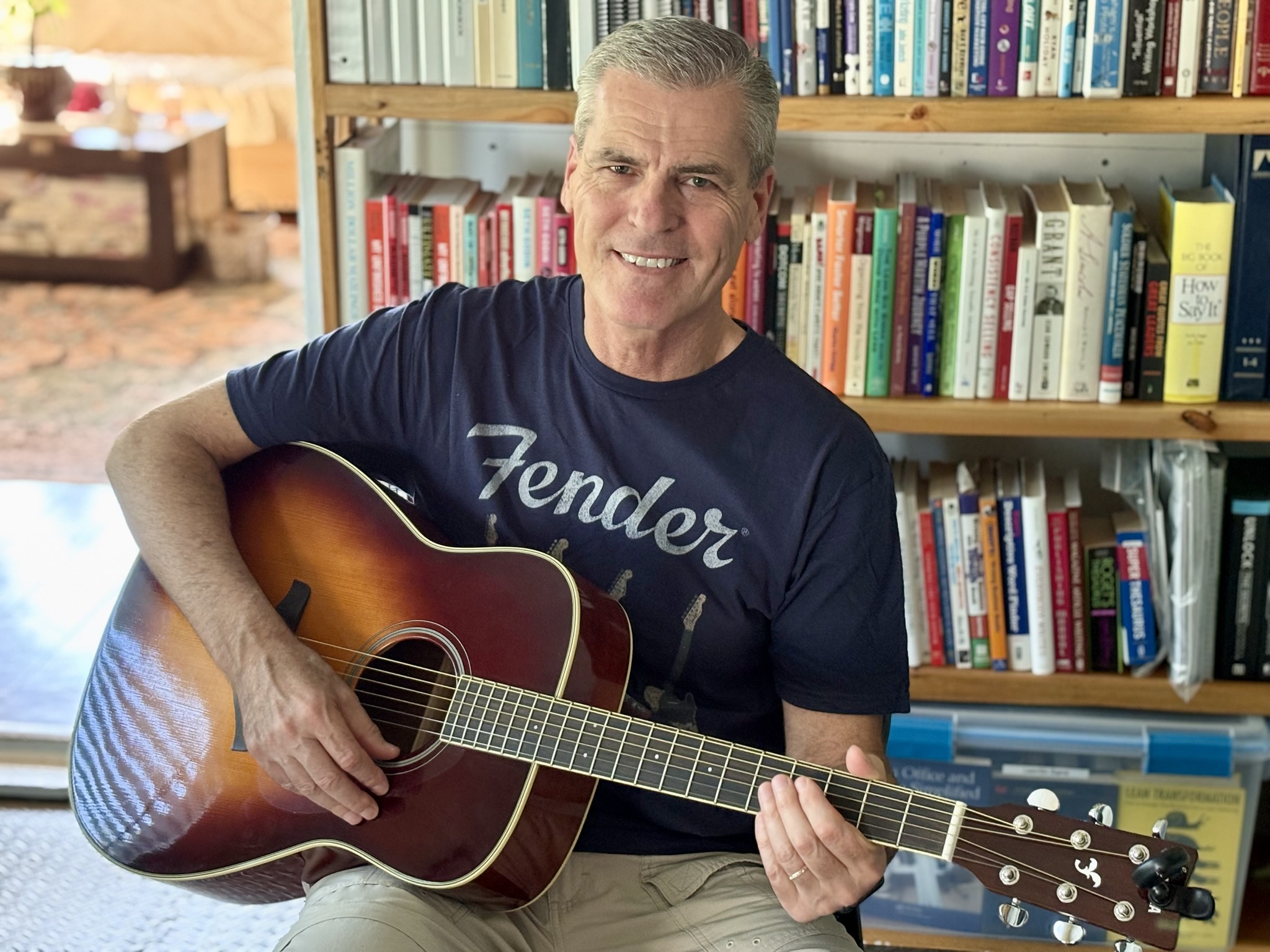
But I recently decided to pick up guitar again. This summer I bought a Yamaha FG-TA acoustic I found on Facebook Marketplace.
My little buddy Bella
I couldn't wait to get home. There I was, sixty-one years old, sitting in a chair in my living room, trying to dust off those old chords and prove to my date of 36 years I could actually play a thing or two.
When we're building a business and making a living, it's easy for a packed calendar and demands of clients to make something as simple and fulfilling as playing a guitar feel like squandering time.
But the opposite is true.
Here's what I want you to get out of this issue:
- What four years of brain scans found in people who picked up an instrument in their seventies
- Why the thing you keep saying you'll do "someday" never happens
- How to practice anything and make two hours of progress in twenty minutes
I left the corporate politics and incompetent managers years ago and built a business that deserves me.
Maybe you did the same. You walked away from the cubicle farm and steady paycheck and built a consulting practice. Eventually, your calendar was consumed by finding, winning, or keeping clients.
So the fishing gear stays in the garage. The golf clubs stay in the trunk. The book you started in March is still face down on the nightstand, cracked open at page forty.
And you still bring it up at dinner. In the future tense. "When things settle down, I'm going to get back to that."
You've been saying it for three years. Things have not settled down.
Let's be honest.
They aren't going to.
A friend of mine has talked for five years about opening a little nano-brewery. The kind with exposed brick, reclaimed wood, a chalkboard menu, and beers named after his dogs. He's pictured it a thousand times. As far as I know, he has never brewed a single batch of beer.
So he keeps it as a kind of joke. A throwaway line at the end of a conversation that gets a chuckle and moves things along. Because if he ever said it seriously, somebody would ask him the obvious follow-up question. "Oh, nice. What kind of beer do you brew?"
You've got one of these. And you've kept it a joke for exactly the same reason.
Then I started to realize... I always treated a hobby like a reward. Something you get to do once the work is finished.
The work is never finished. You're not going to fix that with a better calendar. It's the nature of building a business and a life at the same time.
So a hobby isn't the prize for finishing. It's the maintenance on the most important instrument you have, which is...YOU.
Researchers at Kyoto University ran a study where they took a group of older adults with no musical background. Average age seventy-three. They taught them to play an instrument for four months. Then they went away for four years and came back with an MRI machine.
About half had kept playing. The other half quit and picked up other hobbies.
The ones who quit aged normally, right on schedule. They lost verbal working memory, along with gray matter in a part of the brain called the putamen.
The ones who kept playing didn't. Same age, same four years, and they kept both.
The lead researcher, Kaoru Sekiyama, said, "It's never too late to start playing an instrument, and starting in old age may have major benefits."
Just to be clear, I'm not old. I'm 31 in each leg.
But wow. Seventy-three, starting from nothing.
And you've decided you're too far down the road to pick something up.
Three things I've figured out, mostly by doing them wrong first, which seems to be how I always learn. I suppose it's how all of us learn.
One. Pick something that pays you nothing.
If it feeds the business, it's work dressed in camouflage. The podcast about your industry doesn't count. The book on pricing doesn't count. My guitar earns me exactly zero dollars. That is the entire point.
Two. Practice it like a process, not a pastime.
Plan, Do, Check, Adjust. PDCA. Every quality system I've worked with for thirty years runs on it. It's perfect, deliberate practice. Turns out it works well on a fretboard, too.
Anders Ericsson spent a career studying how people actually get good at things. Real practice has a specific target, your full attention, and honest feedback. Real progress lives just beyond what you can already do.
So I don't just strum chords I already know, which is pleasant but does nothing to help me improve. I play things just beyond my comfort zone. Something Steven Kotler of the Flow Research Collective calls the "challenge-skills sweet spot."
I learn a new chord set or riff, play it slowly (and really bad at first), record thirty seconds and listen back. Then I speed it up until it breaks again.
Twenty minutes of that beats two hours of wandering aimlessly. And the Kyoto study confirmed that the people who held their gains were the people who kept going. Use it or lose it, as they say.
Three. Notice where it puts you.
We talked a few weeks back about the emotional whirlwind, and how your emotional state decides which moves you can see. It's also true that you can't puzzle through how to fix your pipeline and be curious about a chord shape at the same time. The brain won't do both at once.
You don't jump from worried straight to joyful. But you can get from frustrated to interested, and interest is the first rung on the positive side.
I want to be honest about where I am with this. I'm not good (yet) at playing guitar. Nobody would pay a nickel to hear me play.
But I walk into my office with a different swagger in my step by keeping my daily practice streak going. More patient and adaptable. Less brittle when something goes sideways at eleven in the morning.
And that question that follows every one of us around after a certain age, the one about whether it's too late... it stopped nagging at me the way it used to.
The bigger surprise was what it did to the rest of my week.
No athlete trains one muscle and calls himself fit. The guitar works the part of my brain the business never asks for, and the part it does ask for is sharper on the days I play.
Three things to take with you:
1. If it pays you, it isn't the hobby. The minute it feeds the business it's work, and work is the thing you're trying to step out of for an hour.
2. Practice it like a process. Plan, do, check, adjust works on a chord change the same way it works on a production line. Twenty deliberate minutes beat two lazy hours.
3. The point was never the guitar. It's cross-training. Give your brain something the business never asks of it, and the part the business does use gets better.
P.S. I recently purchased a Fender Telecaster electric guitar with a spalted maple top and twin humbuckers. I pick it up from the music store tomorrow. I’m looking forward to releasing my inner Van Halen.
“We are what we repeatedly do. Excellence, then, is not an act but a habit.”
Will Durant, summarizing Aristotle
Want to dive deeper? Check out these related articles:
👉 The Prosperous Consultant | Issue #31
👉 The Prosperous Consultant | Issue #30
You might also find these interesting:
🔎 The "Connect" Call Prep Checklist
🔎 Sales Series Part 3 of 7: Discover
P.S.: When you're ready, here are more ways I can help you...
Business Advisors Needed:
If you’re looking to scale strategically, attract better clients, and create sustainable momentum, let’s talk.
Design a Consulting Practice That Pays Well and Lets You Live Well
A free weekly newsletter for consultants who want predictable income, premium positioning, and sustainable growth.
In The Prosperous Consultant, each issue explores how to design your business around how you want to live, covering pricing, positioning, mindset, and practical strategies that create real options over time.
We hate SPAM. We will never sell your information, for any reason.
