
What was under the blanket
May 12, 2026
THE PROSPEROUS CONSULTANT
Turn your decades of expertise into a premium consulting practice built around the life you want.
Issue #19
I watched my son Nathan receive a life-saving award yesterday.
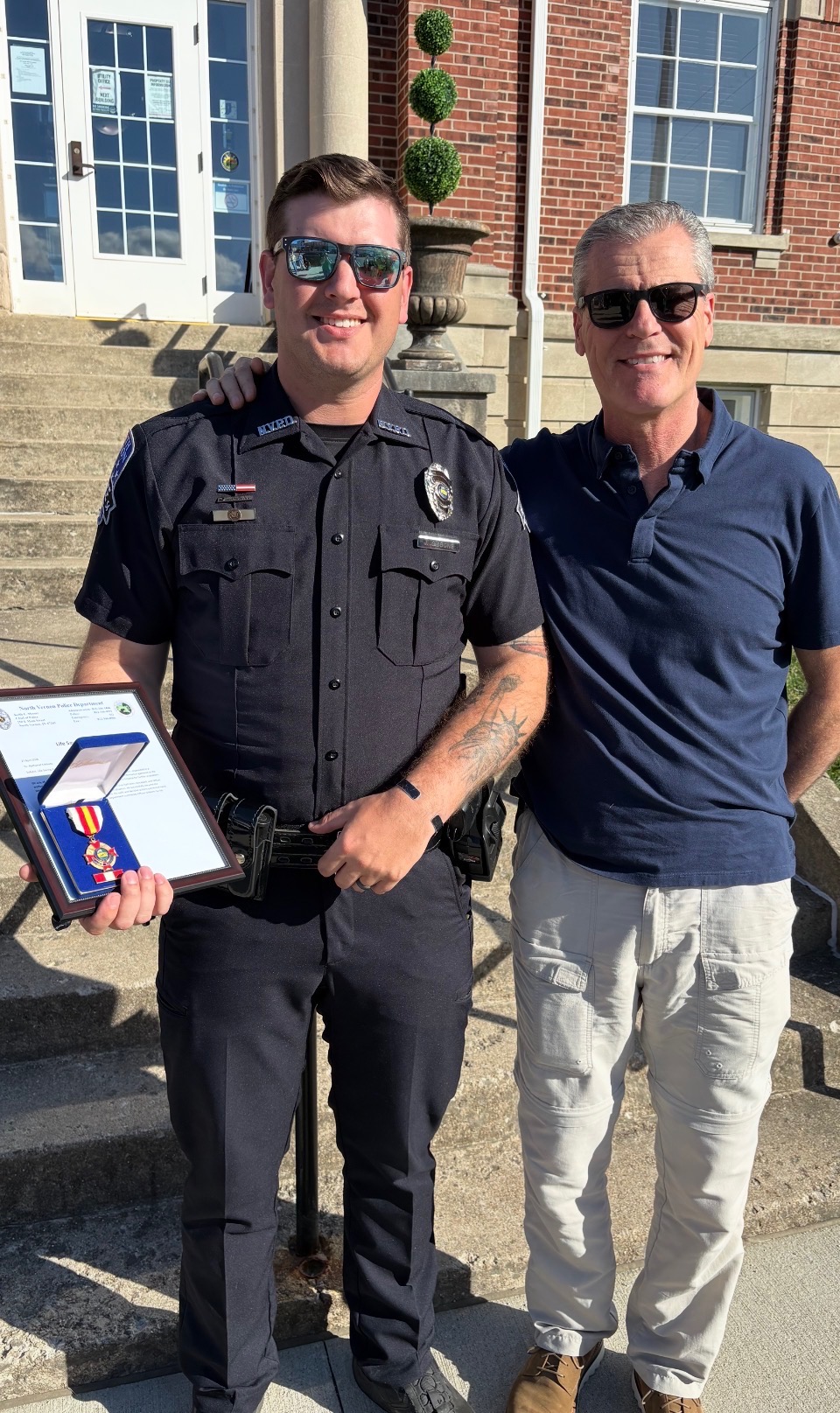
He wrestled a knife away from someone who was suicidal and doing everything in their power to shove it into their neck.
Watching your son stand up in front of his department and get recognized for saving someone’s life… there’s no version of that you can experience over a screen.
Our family went to dinner afterward. Tabbi, both boys and their wives, and our new grandson.
No phones. Two hours around a table, unhurried, connecting, listening.
I listened to my sons talk about what they’re learning, where they’re growing, what they’re figuring out about their careers and themselves.
Things they don’t learn from AI, or a Zoom training session, or a podcast.
They’re learned in the heat of battle, in real life, solving real problems with real consequences.
I drove home thinking: We all need more of that.
The time listening and connecting, I mean.
And I thought too, about what that dinner table has to do with why some consultants are thriving right now while others watch what they thought were their competitive advantages disappear.
This week I want to talk about three things:
-
Why the growing backlash to AI isn’t just noise, and what it’s actually telling us about the future
-
Why your competitive moat is dissolving right now, and what to do about it
-
What your 20+ years of experience is worth in a room full of AI-generated everything
A developer named Matt Shumer spent six years building an AI startup. He wrote an essay called ‘Something Big Is Happening’. Not for his peers in tech. For his friends and family. For everyone just starting to notice what was unfolding around them.
He’d been watching the gap between what he was telling them and what was actually happening grow too wide. He decided to close the gap.
He described a Monday morning: told the AI what he wanted to build, in plain English, then walked away from his computer for four hours. When he came back… the work was done. Not a rough draft. The finished thing. Built, tested, iterated, approved, without him.
His words: “I am no longer needed for the actual technical work of my job.”
The essay reached 80 million people. And most of them didn’t respond the way he intended. They felt the question underneath: If that’s happening to him, what does that mean for me?
If you’ve spent 20 or 30 years becoming genuinely excellent at something difficult… and you read something like that… it’s reasonable to wonder where you fit.
I’ve started to feel it myself. On calls. In emails that land in my inbox at 6 in the morning. People aren’t just frustrated with the "over-promises" of AI. They’re asking a real question about whether they still matter.
Here’s what I’ve been thinking that dinner...
The businesses watching their advantages disappear right now built them on access.
Access to technical talent.
Access to capital. Access to specialized tools and infrastructure that most people couldn’t afford.
That was the moat. You could do what others couldn’t. You had the resources.
AI collapsed that barrier.
So yes, that moat is gone.
But that’s a story about a different kind of business than yours.
You didn’t build your practice on access to resources. You built it the same way the important things get built… not from a training program, but from the heat of battle. Real conversations with real stakes. Moments that required you to be right, because your skin, and the skin of lots of others, was on the line if you weren’t.
Decades of that produces a kind of knowing that AI cannot generate from a prompt.
The moment in a client conversation when you know, before the spreadsheet does, how the next six months will unfold. The question you raise that nobody else in the room thought to ask. Trust earned one conversation at a time, never manufactured.
That’s judgment. That’s taste. Those are the exact words people are now using to describe what AI cannot replicate. You’ve been building both of them for years. You just didn’t know they had a name.
And the backlash that’s growing isn’t only emotional.
People are tired of talking to bots. They want a human who has been where they are. Someone who has made the call they’re about to make… and lived with what came after.
I’ve been doing VIP intensives with clients these past several weeks. Full days. No phones competing for attention. No agenda except the work that matters most. Just the conversation, unhurried, structured in the right places and in others, simply following wherever it needs to go.
I have one coming up with a retired two-star Admiral.
Every time I walk out of those rooms, I’m carrying something I couldn’t have picked up over Zoom.
Not because the content was more complex, but because the conversation goes somewhere different when there’s nowhere else to be.
The idea that surfaces during the break. The thing someone says out loud that they didn’t know they were going to say.
The moment that shifts the whole direction of the work, and neither of you saw it coming.
You can’t get that on a screen.
AI can build almost anything now. What it cannot do is be in the room with you.
I want to come back to Nathan.
The official record describes what happened as an individual who “produced a concealed weapon.” What that means in the actual room: she had a blanket across her lap. Nathan was alone with her, trying to reach her, watching. The blanket gave nothing away.
She pulled out a knife and turned it on herself.
He grabbed her hand.
Officer Christopher Allen came back through the door. Together they wrestled the knife free and got her to the hospital. Resolved, as the official account puts it, without injury.
A life was saved because two people were in that room… present, trained, and capable of making the right call in a moment that gave them no time to think.
Nathan didn’t know the knife was there. Nothing told him. No data, no system, no prompt. What kept him close enough to act was built from real training, real rooms, real consequences when the call goes wrong.
That’s the part that doesn’t come from a certification program. It comes from being in enough rooms that you know what to watch for before it shows itself.
Your clients aren’t hiding knives. But they are hiding things. The real problem underneath the presenting one. The decision they’ve already made and haven’t told you yet. The fear driving the call they scheduled three weeks ago.
The reason they trust you with it is the same reason Nathan was close enough to reach her. Training and being present when it counted.
You don’t have to out-build AI. You have to out-human it.
Your lived experience, learned skill, and pattern recognition is the final checkpoint between what AI produces and a decision that sticks. The question worth asking yourself right now isn’t whether AI is going to replace you. It’s whether you’re charging what you're worth.
Three things to take with you:
- The moat that’s dissolving right now belonged to businesses built on access to resources. That was never your moat. Don’t mourn what was never yours.
- The growing backlash to AI is a market signal. Trust in humans with real, earned experience is getting harder to find, not easier. That’s a tailwind for the consultant who has spent decades becoming the person in the room.
- Your expertise is the judgment seat AI cannot fill. Not a nice-to-have. The final checkpoint. Price it like it is.
P.S. I drove home from that dinner thinking about how rarely I let myself be in a room without an agenda. The award ceremony wasn’t scheduled to teach me anything. But it did. Whatever your version of that looks like this week… go find it.
Want to dive deeper? Check out these related articles:
👉 The math has been lying to you
👉 You don't have a time problem
You might also find these interesting:
🔎 The 4-Part Formula for Consistent Lead Generation
🔎 The "Predictable Lead Generation" Prompt
P.S.: When you're ready, here are more ways I can help you...
Business Advisors Needed:
If you’re looking to scale strategically, attract better clients, and create sustainable momentum, let’s talk.
Design a Consulting Practice That Pays Well and Lets You Live Well
A free weekly newsletter for consultants who want predictable income, premium positioning, and sustainable growth.
In The Prosperous Consultant, each issue explores how to design your business around how you want to live, covering pricing, positioning, mindset, and practical strategies that create real options over time.
We hate SPAM. We will never sell your information, for any reason.
